
What size generator does a Berkshires home need?
Well pumps, boilers, propane, and heat pumps. The real arithmetic behind sizing a standby generator for a Berkshire home, so you can follow the quote.
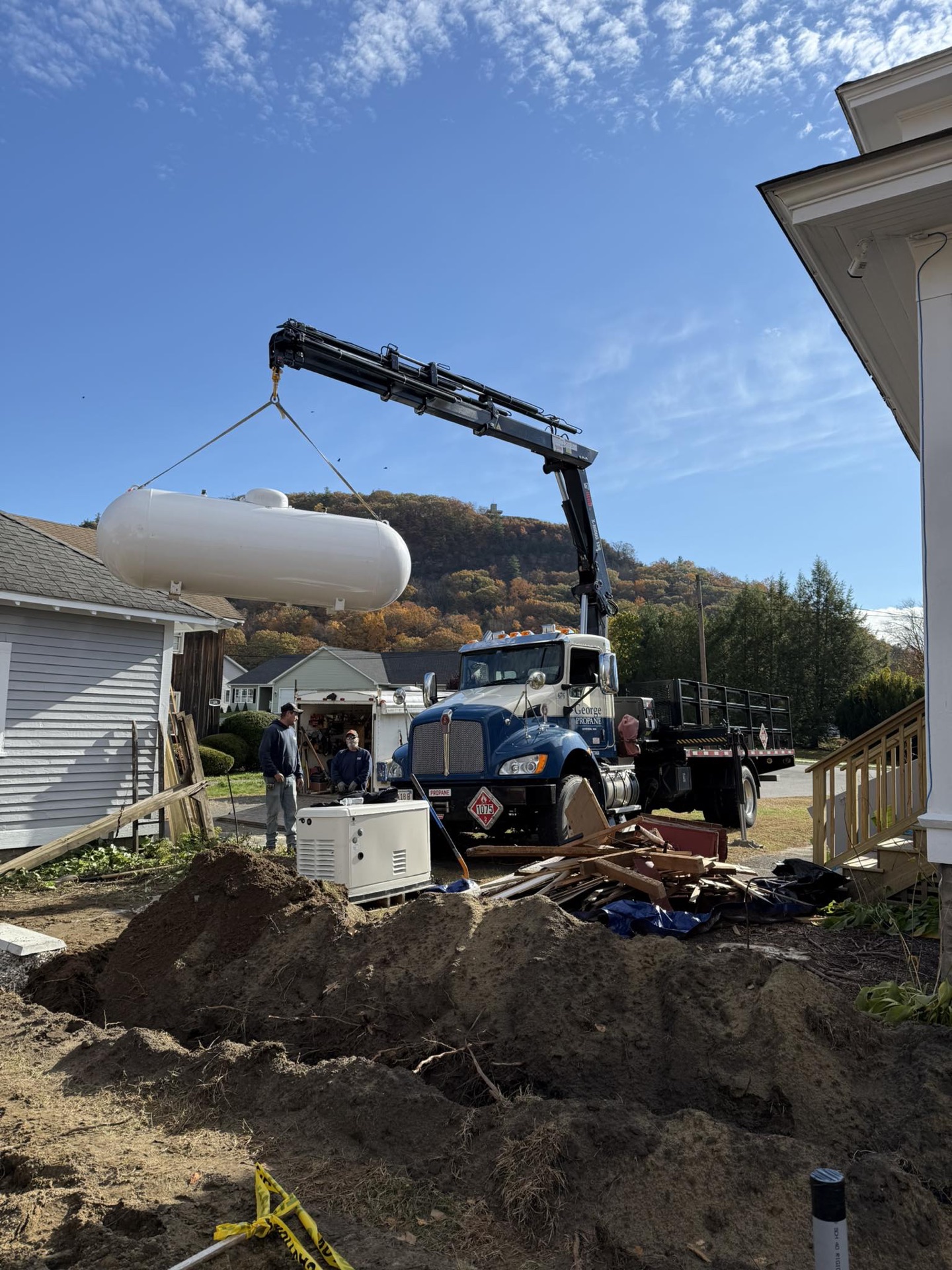
The first question on almost every sales call: what size do I need? It depends on the house, and a good installer does the arithmetic instead of guessing. Here is how the arithmetic works, so you can follow along when somebody quotes you a number.
Start with what has to stay on
A generator is sized to the loads it carries, so the first step is deciding what your house needs during an outage. In town, the list is usually heat, refrigeration, lights, and the internet. Out in the hills it gets longer, because so many homes around here are on drilled wells. No power means no water: no taps, no toilets, no shower. The well pump goes to the top of the list, and it is usually the biggest single number in the calculation. A one horsepower submersible pump draws around 1,000 watts running and two to three times that for the moment it takes to start. The generator has to carry that surge on top of everything else already running.
Heat is the other big variable. An oil or propane boiler barely registers. The burner, circulators, and controls together draw a few hundred watts. A forced hot air furnace adds blower load. Air source heat pumps are a different story. They are efficient machines, but they move heat with electricity, and backing one up takes real capacity. If your house heats with heat pumps, say so early in the conversation, because it changes the size class of the generator.
The rough numbers
| Load | Running watts | Starting surge |
|---|---|---|
| Well pump (1 hp) | 1,000–1,500 | 2,000–4,000 |
| Refrigerator or freezer | 150–300 | 800–1,200 |
| Boiler, burner and circulators | 300–500 | 500–800 |
| Sump pump | 800–1,000 | 1,500–3,000 |
| Heat pump, per ton | 1,000–1,500 | 2,500–5,000 |
| Electric water heater | 4,500 | 4,500 |
Add up the running watts for everything you want on at once, then make sure the unit can absorb the largest starting surge on top of that. For most homes in our service area the answer lands between 14 and 26 kilowatts, which is air-cooled standby territory for Generac and Kohler. A larger home, a heated barn or shop, or a whole-house heat pump system pushes you into liquid-cooled territory, which is a different machine at a different price.
Fuel is half the sizing question
Where the gas mains run, in parts of Pittsfield, Lee, Lenox, Great Barrington, and North Adams, a standby generator draws natural gas and runs as long as the utility does. Most of the hilltowns never got mains. Becket, Otis, Sandisfield, Monterey, New Marlborough: those homes run on propane, and the generator drinks from the same tank as the heat.
That matters because consumption scales with the machine. A 22 kilowatt unit at half load burns roughly two gallons of propane an hour. A 500 gallon tank only ever fills to 80 percent, so call it 400 usable gallons, shared with your boiler in the middle of winter. On paper that is over a week of continuous runtime, which is plenty. But it is a number worth knowing before a storm rather than during one, and sometimes the right answer to a sizing question is a slightly smaller generator and a bigger tank.
Sizing without the upsell
An oversized generator costs more to buy, more to install, and more to feed, and it does not run your house any better. We do a load calculation on every quote: walk the panel, count the real loads, ask how you live in the house. If a 14 kilowatt unit covers it with room to spare, that is the unit we will recommend. We have been at this since 1991, in a county where word about a bad install travels fast.
If you want a number for your own house, request a quote or read about how we handle generator sales. We will show the math.
Talk to a real person.
Same-day callbacks, family-owned since 1991. We will answer the question your house is actually asking.